
[Interview] Sungho Ahn, CEO of Vololand
Economy Chosun — By Yong-sung Lee, International Affairs Correspondent
Published October 7, 2025 — Updated October 7, 2025, 13:48
U.S. House Moves Toward 100% Tariffs on Chinese Strategic Imports — Agricultural and Military Drones Included, Opening a Major Opportunity for Korea’s Drone Industry
On July 20 (local time), the U.S. House of Representatives introduced a bipartisan bill proposing tariffs of up to 100% on strategic imports from China. Items subject to the tariff include aircraft engine components, freeze-dryers used for sensitive pharmaceutical preservation, and agricultural and military drones. According to the bill, tariffs on strategic Chinese products would be raised in phases — 10% after 180 days, 25% after two years, 50% after four years, and 100% after five years from the law’s enactment.
With the United States moving to push Chinese firms — led by DJI — out of the market on national security grounds, expectations are rising that drone industries in allied countries such as South Korea, Japan, and EU member states could enter a significant growth cycle. The Korean drone sector, long overshadowed by China, is beginning to regain momentum. Although market conditions remain difficult, meaningful progress has been made through independent technology development and overseas patent filings. One of the startups leading this trend is Vololand, headquartered in Ulju-gun, Ulsan Metropolitan City.
Founded in 2021, Vololand designs and manufactures core drone components, systems, and stations entirely in-house. The company has developed a fully unmanned 24-hour drone station, capable of automatic battery charging and swapping, precision landing guidance, and remote monitoring and control, allowing drones to operate autonomously with no human intervention. CEO and founder Sungho Ahn has been referred to as a “drone master” for leading Korea’s first drone-station demonstration project and serving as principal investigator for 13 national drone-related R&D programs.
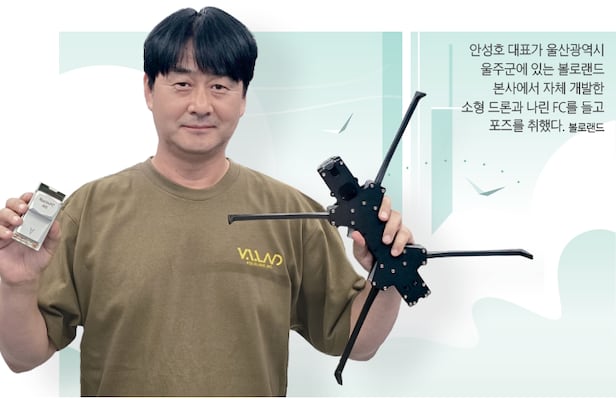
Building on this expertise, Ahn developed Vololand’s own flight controller (FC) — the core “brain” of a drone — and an AI edge computer. Last year, Vololand flew drones with more than 80% domestically developed components in over 1,000 missions, earning recognition as the top-performing company in MOLIT’s national drone-delivery demonstration program. We recently met CEO Ahn during his business trip to Seoul, in a café in Gangnam District. The following is an excerpt from our conversation.

Q&A Interview with Sungho Ahn, CEO of Vololand
Q. What led you to enter the drone business?
A. “I grew up in a financially difficult household, so I enrolled in Busan National Mechanical Technical High School, majoring in electrical engineering, because there was no tuition. I later studied computer engineering at university and then served four years in the Air Force as a non-commissioned officer. My specialty was maintenance of fighter jets, working on avionics, telecommunications, and navigation equipment. Looking back, those experiences gradually built the expertise required to develop drones. After my discharge, I worked as a software developer, then moved to the shipbuilding industry and spent 15 years designing vessels. The shipbuilding boom allowed me to earn a very high salary. But I wanted to return to a computer-related field and joined an IT company that also did drone development. After working there for four years, I left and founded Vololand.”
Q. What is the meaning behind the name “Vololand”?
A. “It combines ‘Volo’, meaning ‘to fly’ in Latin, and ‘land’, meaning ‘to land’. Just like the name implies, Vololand’s mission is to enable drones to fly in the sky and land safely on stations to provide services.”
Q. Why did you choose Ulju-gun in Ulsan as the company’s headquarters?
A. “Two of our core team members are from Ulsan (laughs). Ulju-gun is geographically larger and has greater tax revenue than the other four districts of Ulsan. But most importantly, Ulju-gun is truly committed to drones. Our participation in Ulju-gun’s ‘K-Drone Delivery Commercialization Project’ last year was the driving force behind achieving over 1,000 real delivery flights in a single year — something very difficult to accomplish in Korea. I don’t think we’ll ever leave Ulju-gun.”
Ulju-gun invested KRW 800 million (KRW 500 million national funding + KRW 300 million local funding) into the 2024 K-Drone Delivery Commercialization Project, establishing three logistics hubs and 15 delivery points as part of the MOLIT program “Drone Demonstration City Construction.” Vololand handled the drone delivery operations. As a result, Ulju-gun received the Korea Transportation Safety Authority Chairman’s Award, and Vololand received the Minister of Land, Infrastructure and Transport Award, ranking first among participating companies for its localization of core components such as flight controllers and GNSS systems.
Q. What was your experience like providing drone delivery services? Was it profitable?
A. “We operated four 25-kg delivery drones, mainly serving parks and tourist areas in Ulju-gun, including Ganwoljae at 900 meters above sea level. Although the project was supported by national funding to help activate drone delivery services, it’s difficult to generate high profits. Delivery fees range from KRW 3,000 to KRW 10,000 depending on distance, but labor and battery costs are significant. Drone batteries must be replaced after 200–300 cycles and each one costs about KRW 1 million.”
Q. Tell us about the drones Vololand manufactures.
A. “We offer four to five types — from smaller drones priced around KRW 2 million to large delivery drones weighing up to 50 kg and costing KRW 80 million. We also produce 25-kg units priced at KRW 30–40 million, and we have tethered drones connected by fiber-optic cable. Agricultural drones are coming next.”
Q. Why are tethered drones necessary?
A. “Battery capacity limits flight time for wireless drones. With a tether, flight time can be dramatically extended, enabling uses like sports broadcasting and monitoring. Our goal is to extend the cable from the current 100–200 meters to 500 meters. For military communication-relay use, 500 meters is essential.”
Q. Is extending the cable length really that difficult?
A. “A longer cable means more weight, so the drone must be able to carry it. Also, the longer the cable, the greater the voltage drop, which can slow charging speed. If we succeed in extending the cable to 550 meters, a drone could even clean the windows of Lotte World Tower in Jamsil (laughs).”
Q. Is there a case that demonstrates Vololand’s proprietary technological capabilities?
A. “Our ‘Narin FC’ flight controller, which we developed in-house, includes a self-destruct data-removal system. It completely destroys memory and chips containing flight and mission data through three physical mechanisms — high-voltage burning, chemical capsule detonation, and battery ignition — preventing data recovery in case of drone capture during military operations. We have been granted domestic patents and are filing international patents as well.”
Q. With the U.S. phasing out Chinese drones, can the Korean drone industry benefit?
A. “During my recent business trip to the United States, I got a clear impression that American companies want allied drone manufacturers — including Korea — to fill the gap left by China. I anticipated such a shift when tensions between the U.S. and China showed no signs of easing under the Biden administration, so we started preparing early with in-house component and technology development. We recently signed a strategic partnership with Hylio, an American agricultural drone manufacturer, for joint R&D in agricultural and defense drone systems. In Korea, selling 100 drones is a challenge — in the U.S., a single company may order 2,000 to 3,000. Opportunity comes to those who are prepared.”